
Industrial, institutional and corporate catering companies no longer compete only on food quality, manpower and pricing. They are increasingly evaluated on digital ordering, verified meal distribution, subsidy control, service speed, data visibility, compliance reporting, employee experience and integration capability.
This changes the competitive equation.
A catering company that depends on spreadsheets, manual registers, disconnected POS systems and third-party ordering applications may continue serving food—but it will struggle to win technology-driven enterprise contracts.
MealPe gives catering companies a unified technology layer through which they can digitise their own food operations, retain their operating identity and build a scalable institutional catering brand.
MealPe’s platform connects four core applications: the Food Ordering App, Vendor Application, Counter Billing POS and Institutional Admin Dashboard. It also supports fixed meal programmes, RFID, biometric and QR verification, subscription billing, institutional integrations, analytics and managed food-service workflows.
The Direct Answer: Why Should Catering Companies Choose MealPe?

Catering companies should consider MealPe when they want to:
- Digitise their existing catering contracts without surrendering their operational identity.
- Deploy technology under their own or the institution’s branding.
- Manage cafeterias, mess halls, food courts, industrial kitchens and meal subscriptions from one system.
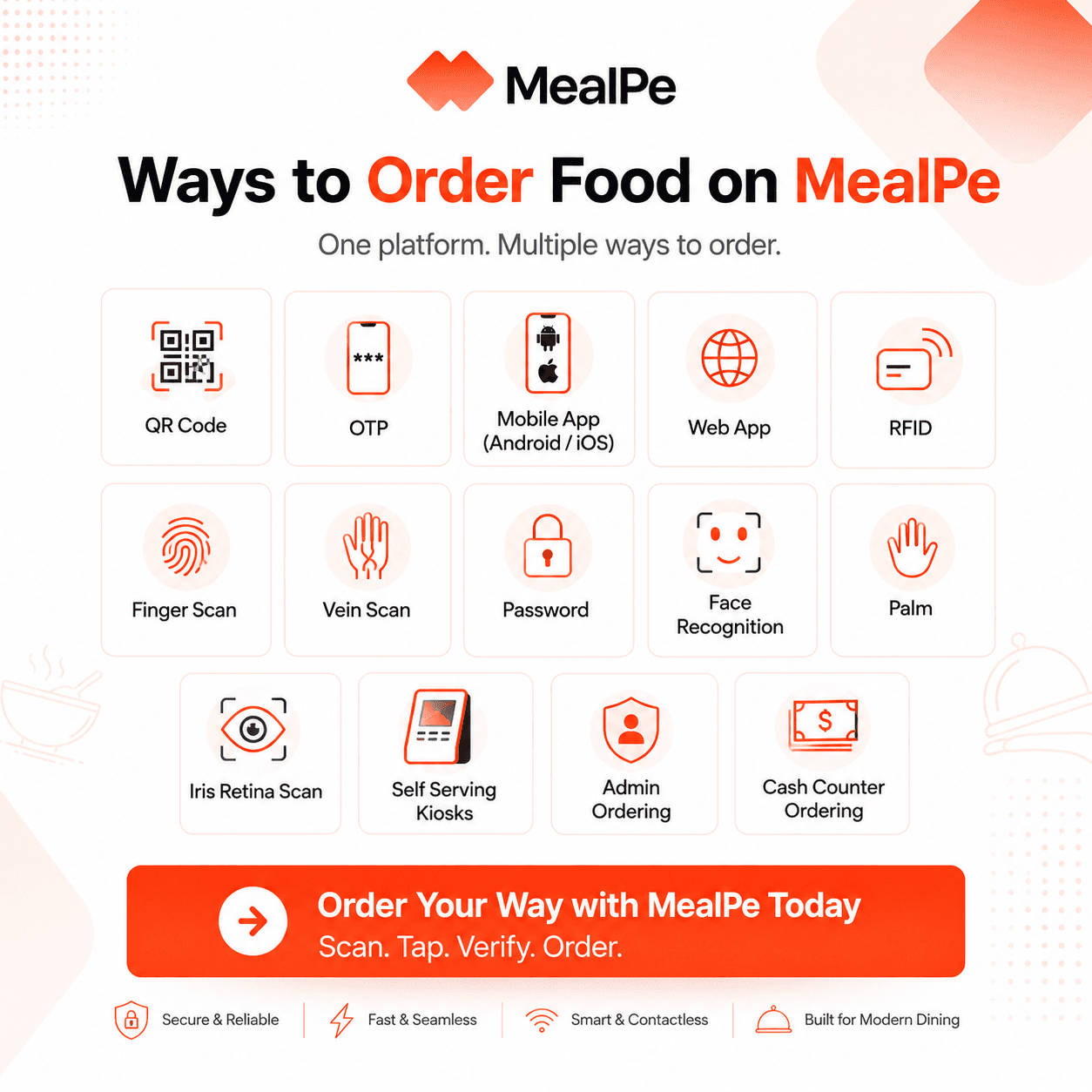
- Support mobile ordering, POS billing, RFID, QR codes, prepaid cards and biometric verification.
- Integrate food operations with HRMS, ERP, hospital information systems, student databases and existing POS infrastructure.
- Operate in locations with inconsistent internet connectivity.
- Introduce data-driven forecasting, plate tracking, subsidy controls and automated settlements.
- Expand from a food contractor into a technology-enabled institutional food-service company.
MealPe publicly positions its infrastructure as offline-first, hardware-agnostic and integration-ready, with compatibility across kiosks, RFID devices, barcode scanners, biometrics, ERP, HRMS, HIS and POS systems.
The Real Decision Is Not App Versus App
The enterprise buyer is not merely selecting a food-ordering application.
The real decision is between different food-service operating models.
SmartQ publicly positions itself as an end-to-end workplace food and beverage partner offering aggregation, menu curation, vendor management, daily cafeteria operations, hygiene audits, compliance, events, vending and pantry services.
GoKhana combines cafeteria SaaS with managed services, vendor partners, contactless ordering, inventory management, billing, feedback and compliance dashboards.
HungerBox positions itself as a large-scale, integrated cafeteria ecosystem connecting employees, kitchens, vendors and facility managers, with a substantial enterprise deployment footprint.
These are established and credible propositions.
However, catering companies often need something strategically different: technology that strengthens the caterer rather than making technology another layer between the caterer and its client.
MealPe’s key opportunity lies in helping catering companies build that technology capability themselves.
What Is MealPe?
MealPe is a B2B foodtech platform designed for complex institutional food operations.
Its platform is organised around four interconnected applications:
1. Food Ordering Application
Users can discover menus, place immediate or scheduled orders, make payments and track order status.
MealPe supports:
- Web, Android and iOS ordering
- Multiple vendors
- Pre-scheduled orders
- UPI, cards and institutional wallets
- Fixed mess subscriptions
- Live preparation notifications
2. Vendor Application
The Vendor Application acts as the operating console for caterers, cafeteria operators, kitchens and food vendors.
It supports:
- Centralised order management
- Dynamic menu control
- KOT and KDS workflows
- Inventory visibility
- Sales reporting
- Order fulfilment monitoring
3. Counter Billing POS
MealPe’s counter-billing system supports walk-in and assisted ordering.
It includes:
- Rapid counter checkout
- Cash and digital payments
- RFID and QR transactions
- Institutional credit
- Kitchen synchronisation
- Digital invoicing
- Shift reconciliation
4. Institutional Admin Dashboard
The dashboard gives corporate administration, facility teams, finance departments and institutional management visibility across the food operation.
It supports:
- Live revenue and order dashboards
- Plate-count tracking
- Vendor governance
- Price and menu controls
- Subscription billing
- Settlement management
- Consumption reporting
- HRMS and institutional database integration
Together, these applications create one operating environment for users, caterers, counter staff, kitchen teams, administrators and finance departments.
Why MealPe Is Strategically Relevant for Catering Companies
1. MealPe Can Function as the Caterer’s Technology Layer
Many catering companies already possess the difficult operational capabilities:
- Central kitchens
- Food-production teams
- Procurement relationships
- Institutional clients
- Dieticians and menu planners
- Site supervisors
- Quality-control processes
- Local culinary knowledge
What they usually lack is a unified digital infrastructure.
MealPe can become that infrastructure.
The catering company continues to operate the kitchen and manage food quality, while MealPe digitises ordering, verification, billing, reporting and institutional governance.
This enables the catering brand to present itself as a technology-enabled food-service operator, rather than merely a manpower or meal-supply contractor.
MealPe also offers managed cafeteria services and vendor aggregation separately from its technology products. This modular structure creates room for different deployment models: technology-only, technology plus implementation, or fully managed operations.
3. MealPe Can Protect Catering Economics
Per-order commissions can become expensive in high-frequency institutional environments.
A corporate cafeteria may process thousands of low-ticket transactions every day. Even a small transaction-linked charge can materially affect catering margins when applied across breakfast, lunch, snacks, dinner and night-shift meals.
MealPe has publicly described certain offerings as commission-free and subscription-oriented. Commercial conditions can vary by implementation, so caterers should document the final pricing structure, transaction fees and payment-gateway charges in the contract.
A predictable SaaS arrangement can help catering companies:
- Price technology into the annual contract
- Protect per-meal margins
- Avoid open-ended platform costs
- Forecast site-level profitability
- Offer technology as a value-added service
- Build recurring software-led revenue into client contracts
The strategic shift is simple: technology becomes a fixed operating capability instead of a variable tax on every meal.
4. MealPe Goes Beyond Corporate Food Courts
A standard corporate cafeteria generally focuses on menu browsing, ordering, payments and pickup.
Industrial and institutional catering is more complicated.
A factory may require:
- Shift-wise meal eligibility
- Worker-ID verification
- Contractor labour segregation
- Meal-slot restrictions
- Subsidised and non-subsidised meals
- Offline verification
- Department-wise cost allocation
A hostel may require:
- Monthly meal subscriptions
- Breakfast, lunch and dinner calendars
- RSVP or meal-skipping cut-offs
- Term billing
- Guest-meal billing
- Expected-versus-consumed plate reports
A hospital may require:
- Staff dining
- Patient meals
- Attendant meals
- Diet-specific workflows
- Ward delivery
- Access-controlled subsidies
MealPe’s Mess Manager supports meal calendars, RSVP-based forecasting, biometric, RFID and QR verification, expected-versus-actual plate tracking, subscription plans and user-level statements. It is publicly positioned for universities, hostels, factories and industrial plants.
That fixed-meal depth is particularly relevant for industrial and institutional caterers.
5. MealPe Supports Multiple Identification and Access Methods
Not every employee, student, worker or hospital attendant will use a smartphone application.
Institutional food systems must accommodate different operational realities.
MealPe supports:
- Mobile ordering
- QR verification
- RFID cards
- Prepaid meal cards
- Biometric verification
- Counter billing
- Manual administrative overrides
- Self-service kiosks
This gives catering companies flexibility to design workflows around the client environment rather than forcing every site into one ordering method.
A corporate office may prefer app-based ordering.
A factory may prefer employee RFID cards.
A residential campus may combine meal subscriptions with biometric entry.
A hospital may use staff cards, patient orders and ward-level delivery in parallel.
One platform can support several operating journeys.
6. Offline Capability Matters in Real Operations
Institutional kitchens cannot stop serving meals because the internet connection is unstable.
Lunch service may involve hundreds or thousands of people entering a dining hall within a narrow time window. If verification hardware or POS terminals become unusable during a network outage, queues and disputes escalate immediately.
MealPe states that its architecture supports offline-first operations and offline-capable hardware for institutional dining environments.
For industrial caterers operating in factories, warehouses, remote campuses and logistics facilities, offline resilience is not a decorative technical feature. It is an operational continuity requirement.
7. MealPe Is Hardware-Agnostic
Catering companies frequently inherit different hardware at different client locations.
One site may already use:
- Android POS devices
- RFID readers
- Barcode scanners
- Fingerprint machines
- Facial-recognition terminals
- Touchscreen kiosks
- Thermal printers
- Existing kitchen-display systems
Replacing all existing infrastructure can increase implementation cost and create procurement resistance.
MealPe publicly describes itself as hardware-agnostic and compatible with kiosks, RFID devices, barcode scanners and biometric systems.
This can enable the catering company to build a practical migration plan around reusable hardware, phased replacement and client-approved capex.
8. MealPe Integrates with the Institution’s Core Systems
Enterprise food service does not operate in isolation.
The food platform may need to exchange information with:
- HRMS
- Payroll software
- ERP
- Student information systems
- Hospital information systems
- Employee identity databases
- Access-control systems
- Accounting software
- Existing POS platforms
MealPe states that it supports ERP, HRMS, HIS and POS integrations, while Mess Manager is described as API-first and capable of integrating with student and employee identity systems.
This allows the caterer to automate processes such as:
- Employee onboarding and exit
- Subsidy allocation
- Department-based billing
- Student meal-plan activation
- Payroll deduction
- Patient or staff eligibility
- Vendor settlement
- User deactivation
- Audit reporting
Integration capability can materially improve the catering company’s tender competitiveness.
9. Closed-Loop Campus Delivery Creates a New Revenue Layer
Food consumption is no longer restricted to the cafeteria.
On large campuses, food may need to reach:
- Hostel blocks
- Office towers
- Hospital wards
- Laboratories
- Factory departments
- Training centres
- Meeting rooms
- Night-shift workstations
MealPe’s Campus Food Delivery service supports location-based ordering, integrated payments, internal delivery-agent assignment, live tracking, time-window rules and central administrative visibility.
This enables caterers to create a controlled, intra-campus delivery model without depending on consumer delivery marketplaces.
The catering company can potentially introduce:
- Delivery fees
- Packaging fees
- Premium desk-delivery menus
- Night-shift delivery
- Meeting-room catering
- Ward or department delivery
- Scheduled snack rounds
The result is not merely convenience. It is an additional, measurable service line.
10. MealPe Helps Caterers Become Data-Driven Businesses
Traditional catering reports often show only:
- Total meals supplied
- Total invoice value
- Raw-material purchase
- Labour cost
That is insufficient for modern institutional contracts.
MealPe can provide visibility into:
- Item-wise sales
- Meal-slot consumption
- Expected versus actual plates
- User-level meal access
- Vendor-level performance
- Peak ordering periods
- Subsidy utilisation
- Order fulfilment
- Settlement values
- Menu demand
- Location-wise delivery
- Wastage indicators
MealPe’s platform includes real-time dashboards, plate counts, billing, settlement and MIS analytics.
This data gives the caterer stronger answers during monthly reviews:
- Why did food cost increase?
- Which menu items are underperforming?
- Which location generates the most demand?
- How much subsidy was actually consumed?
- How many meals were prepared but not taken?
- Which shift has the highest plate variance?
- Which counter creates the longest queue?
- Which vendor requires corrective action?
| Platform | Public Market Positioning | Particularly Strong For | MealPe Decision Advantage for a Caterer |
|---|---|---|---|
| MealPe | Unified institutional food-service platform covering ordering, vendor operations, POS, mess management, hardware, administration, integrations and optional managed services | Caterers seeking modular SaaS, fixed-meal workflows, multi-mode access, institutional integrations | Can act as the caterer’s technology backbone while supporting corporate, industrial, educational, healthcare and residential operations |
| SmartQ | End-to-end workplace F&B ecosystem with food aggregation, menu engineering, cafeteria operations, compliance, events, pantry and vending | Companies seeking a single workplace food-experience partner with an extensive food-partner network | MealPe may be more relevant when the existing catering company wants to retain operational ownership and procure a configurable technology stack |
| GoKhana | Digital cafeteria SaaS combined with cafeteria managed services, partner mapping, contactless ordering and administrative controls | Corporate dining, employee subsidies, vendor management and managed workplace services | MealPe offers a broader institutional narrative around mess subscriptions, shift feeding, hardware verification and closed-loop campus delivery |
| HungerBox | Large-scale end-to-end cafeteria platform connecting employees, vendors, kitchens and enterprise facility teams | High-volume corporate cafeterias and large enterprise implementations | MealPe may fit operators prioritising modular deployment, fixed-meal operations, offline workflows and hardware flexibility |
Which Catering Companies Are the Best Fit for MealPe?
Industrial Catering Companies
MealPe is well suited to caterers operating in:
- Manufacturing plants
- Industrial parks
- Warehouses
- Logistics hubs
- Construction camps
- Worker accommodation
- Multi-shift production facilities
Important capabilities include shift-wise eligibility, RFID or biometric verification, offline operations, prepaid balances, departmental billing and real-time plate counts.
Institutional Catering Companies
MealPe can support caterers serving:
- Universities
- Schools
- Hostels
- Residential campuses
- Hospitals
- Nursing facilities
- Training academies
- Government institutions
These environments require subscription management, meal calendars, eligibility rules, user databases, attendance controls, term billing and institutional reporting.
Corporate Catering Companies
Corporate caterers can use MealPe for:
- Employee meal ordering
- Cafeteria subsidies
- Multi-vendor food courts
- Cashless transactions
- Pre-ordering
- Scheduled pickup
- Pantry ordering
- Meeting-room catering
- Office-block delivery
- Multi-location dashboards
Multi-City Catering Brands
A multi-city catering company needs consistency without destroying local flexibility.
MealPe can help standardise:
- Digital menus
- Ordering journeys
- POS workflows
- Vendor reports
- Settlement formats
- Subsidy rules
- Feedback collection
- Audit trails
- Client dashboards
Individual sites can retain local menus and vendors while the caterer’s leadership receives central visibility.
The Enterprise ROI Case for MealPe
MealPe should not be evaluated only as a software expense.
It should be evaluated against the operational leakage it can control.
Core ROI Metrics
| Metric | Measurement |
|---|---|
| Forecast accuracy | Difference between expected, prepared and consumed meals |
| Food wastage | Unsold or unconsumed quantity as a percentage of production |
| Subsidy leakage | Subsidy allocated minus subsidy attached to verified consumption |
| Digital adoption | Digital orders divided by total orders |
| Order-to-service time | Time between order confirmation and fulfilment |
| Queue duration | Average waiting time during peak meal periods |
| Plate variance | Prepared meals minus verified meals |
| Settlement cycle | Days required to reconcile and settle vendor accounts |
| Billing disputes | Number and value of disputed meal invoices |
| Revenue per user | Total food revenue divided by active users |
| Menu conversion | Orders per menu item impression |
| Service availability | Percentage of operating time without critical interruption |
A caterer should establish baseline values before deployment and measure the same indicators after 30, 60 and 90 days.
How to Implement MealPe Across a Catering Business
A 30–60–90-Day Deployment Framework
Days 0–30: Discovery and Process Mapping
The first phase should document:
- Client locations
- User categories
- Existing meal programmes
- Vendors and kitchens
- Payment methods
- Subsidy structures
- Current POS hardware
- Identity systems
- Reporting requirements
- Connectivity conditions
- Existing reconciliation processes
Integration Workstreams
Identity and User Data
Map employee IDs, student IDs, worker codes, patient categories and contractor records.
Acceptance Criteria
Every active user should have the correct institution, location, department, meal entitlement and payment configuration before go-live.
Menus, Meal Plans and Pricing
Configure paid menus, fixed meal plans, subsidy rules, time slots, special meals and guest pricing.
Acceptance Criteria
Every item and meal plan must have a defined price, tax configuration, availability window, kitchen mapping and eligible user group.
Days 31–60: Pilot Deployment
Launch one controlled site, shift or cafeteria.
Test:
- Ordering
- Counter billing
- KOT routing
- RFID and biometric access
- Refunds
- Subsidies
- Offline transactions
- Settlement reports
- User onboarding
- Menu changes
- Escalation protocols
Days 61–90: Scale and Optimisation
After the pilot stabilises:
- Roll out additional locations
- Standardise operating SOPs
- Introduce central dashboards
- Automate settlements
- Activate advanced analytics
- Implement campus delivery where required
- Benchmark locations
- Review menu performance
- Identify wastage and service bottlenecks
Conclusion: MealPe Helps Caterers Become Foodtech Companies
SmartQ, GoKhana and HungerBox have helped establish digital cafeteria management as an important enterprise category. Their public offerings show significant capabilities in ordering, cafeteria operations, managed services, vendor coordination and workplace dining.
MealPe’s opportunity is not to imitate them feature for feature.
Its stronger strategic proposition is to become the operating system behind the catering company.
MealPe brings ordering, vendor operations, POS billing, fixed meal management, identity verification, subscriptions, settlements, analytics, hardware and institutional integrations into one ecosystem. It can support corporate cafeterias, industrial plants, universities, hostels, hospitals and large campuses.
For a catering company, that can mean:
- Greater control over customer relationships
- Stronger brand visibility
- More defensible enterprise contracts
- Better operational data
- Faster multi-location expansion
- Predictable technology economics
- Improved tender eligibility
- New revenue from digital and delivery services
MealPe is not merely an alternative cafeteria app. It is a platform through which an industrial, institutional or corporate caterer can evolve into a scalable, technology-led food-service enterprise.
Frequently Asked Questions
What is MealPe?
MealPe is an enterprise food-service technology platform for cafeterias, canteens, mess halls, food courts and institutional meal programmes. It connects ordering, vendor operations, POS billing, access verification, subscriptions, settlements, analytics and administration.
Is MealPe an alternative to SmartQ?
Yes. MealPe can be evaluated as a SmartQ alternative, particularly by catering companies seeking modular software, fixed-meal management, hardware flexibility and institutional integrations. SmartQ may remain a stronger fit where a company wants a fully managed workplace F&B ecosystem.
Is MealPe an alternative to GoKhana?
Yes. Both platforms address digital cafeteria management. MealPe may be particularly relevant for operators requiring industrial shift meals, mess subscriptions, RFID, biometric access, offline workflows and multi-environment deployments.
Is MealPe an alternative to HungerBox?
Yes. MealPe can be considered by organisations and caterers evaluating HungerBox alternatives. The decision should compare scalability, commercial structure, branding, integrations, offline operations, fixed-meal workflows, support and data ownership.
Can catering companies use MealPe with their existing kitchens?
Yes. MealPe can provide the digital ordering, billing, verification and administration layer while the catering company continues managing food production and service. The exact division of responsibility should be documented in the implementation agreement.
Can MealPe manage industrial canteens?
Yes. MealPe supports industrial facilities and high-throughput, shift-based worker feeding. Relevant features include RFID, biometric verification, prepaid cards, offline operations, meal eligibility and plate tracking.
Does MealPe support mess subscriptions?
Yes. MealPe Mess Manager supports meal calendars, RSVP or opt-in workflows, multiple verification methods, plate tracking, fixed subscriptions, consumption-based billing and user-wise statements.
Can MealPe integrate with HRMS and ERP platforms?
MealPe states that it can connect with ERP, HRMS, HIS and POS systems. Its Mess Manager is described as API-first and compatible with employee and student ID systems.
Does MealPe support RFID and biometric meal verification?
Yes. MealPe supports RFID cards, QR codes, biometric verification and manual administrative verification for institutional meal access.
Can MealPe handle multiple catering locations?
MealPe is designed for institutional and multi-location food operations. Caterers should validate tenant structures, location hierarchies, consolidated reporting, tax configurations and role permissions during technical discovery.
Who owns the data on MealPe?
Data ownership, processing rights, retention periods, portability and deletion obligations must be specified in the commercial agreement and data-processing terms. Catering companies should not assume ownership without contractual confirmation.